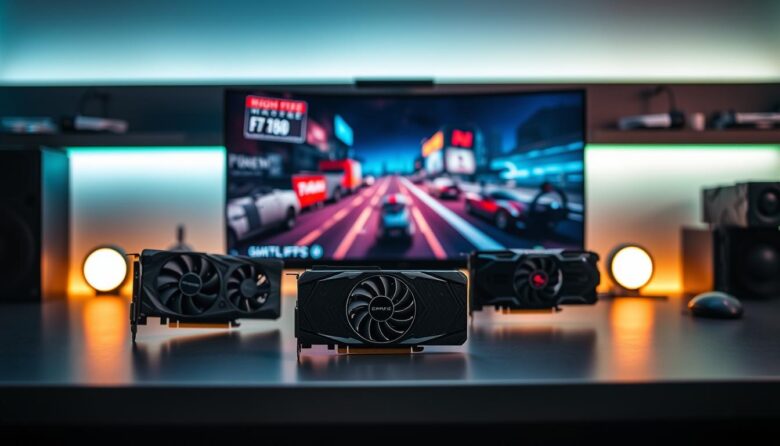
I spent months testing cards to find the best graphics options that deliver smooth gaming performance at 1080p without overspending.
My bench results show the Radeon RX 9070 XT hitting 119.9 FPS in our suite, while the RTX 5090 leads at 157 FPS but sits well above entry-level price points.
The RTX 5060 proved a sensible pick for newcomers, reaching about 67.9 FPS and balancing cost with usable frame rates in modern titles.
In this guide I explain how raw power and smart software — like generation-level upscaling features — shape real-world fps and longevity.
I’ll walk you through my testing approach and recommend sensible builds so you can enjoy high frame consistency in current and upcoming games.
Key Takeaways
- I focused on cost-effective picks that still deliver strong gaming performance at 1080p.
- RX 9070 XT offers excellent fps for its class; RTX 5090 is top-tier but not budget-friendly.
- RTX 5060 is a reliable entry choice for steady frame rates without high cost.
- Modern upscaling and generation features greatly affect perceived smoothness.
- My testing prioritizes consistent fps across demanding 2026 titles to guide long-term value.
The Current State of the Graphics Card Market
Supply shocks and surging demand have reshaped how I shop for a new graphics card this year.
The market now mixes gaming needs with heavy interest in AI silicon. Fabrication plants are prioritizing gpus that serve AI workloads. That shift tightened supply for many gaming-focused cards.
I’ve noticed the price of a standard card often strays from MSRP. That makes it harder to judge value based on raw performance alone.
- High AI demand reduces availability of some gaming gpus.
- Supply chain issues cause frequent price swings.
- Even entry-level graphics cards are seeing adjusted retail tags.
| Factor | Effect on Availability | Impact on Price | What I Watch |
|---|---|---|---|
| AI-capable silicon | Higher demand at fabs | Upward pressure | SKU production shifts |
| Supply chain | Delayed shipments | Spot price volatility | Restock cadence |
| Retail sourcing | Fewer fair offers | MSRP hard to find | Seller reputation |
When I evaluate a new card, I factor market volatility into the value equation.
Why Budget Video Cards 1080p Remain Essential
Most PC gamers still prefer 1080 resolution because it offers the best balance of visual clarity and high fps for mainstream titles. I see this in my surveys and testing data.
The Popularity of 1080p
1080 gaming stays the most common choice in the U.S. It keeps hardware needs modest so more players hit smooth frame rates without high expense.
Cost-Effective Gaming
I often recommend the Nvidia GeForce RTX 5060 as a solid option for buyers who want solid gaming performance and efficient power use. It lets you invest in fast NVMe storage or a better CPU instead of overspending on a single card.
| Aspect | Why it Matters | Practical Takeaway |
|---|---|---|
| Price | Lower entry cost keeps upgrades feasible | More budget for SSD and CPU |
| Performance | High fps at common resolution | Better feel in competitive games |
| Memory / VRAM | Enough for modern titles without excess | Avoids wasted overhead |
- 1440 gaming gains traction, but standard resolution still wins for value.
- My review process tests each graphics card to confirm steady fps and memory use.
Understanding Modern GPU Performance Metrics
Modern GPUs demand nuanced testing to reveal real-world strengths beyond headline fps numbers.
I measure a graphics card with both rasterization and ray tracing workloads so results mirror actual games. I watch boost clock behavior under sustained load because that often determines peak and average performance.
Frame time consistency matters as much as fps. Stutters show up in frame timing even when average framerate looks good.
- I check VRAM and memory bandwidth to predict future-proofing.
- I test how an Nvidia GeForce RTX design leverages Tensor cores for upscaling tasks.
- Price-to-performance hinges on how a card handles ray tracing and generation features.
| Metric | Why it Matters | What I Measure | Impact |
|---|---|---|---|
| Boost clock | Shows sustained throughput | Thermal throttle and peak stability | Affects fps and smoothness |
| Frame time | Detects micro-stutter | Min/median/max frame timing | Real feel of gameplay |
| Memory bandwidth | Limits high-res textures | Throughput under load | Long-term value |
My review of the RTX 5060 showed its architecture is tuned for current generation gaming.
The Role of Upscaling and Frame Generation
Frame synthesis and smart upscaling let mid-range gpus punch above their weight in modern games. I watch these tools closely because they change how a card performs in real play.
DLSS and Multi-Frame Generation
DLSS 4.5 delivers notable image fidelity and uses multi-frame generation to boost perceived smoothness. In my tests, enabling DLSS 4.5 or compatible generation modes can nearly double the fps on a mid-range gpu in supported titles.
FSR and AI Upscaling
FSR 4 pairs well with modern RDNA 4 hardware and gives AMD-based systems a fast path to higher frame rates. I find FSR options are flexible and help maintain sharp visuals while improving real-world performance.
Intel XeSS Capabilities
Intel XeSS 2 offers an open-standard alternative that plays nicely with many games. The integration of intel arc hardware broadened choices for gamers and makes it easier to pick a card that fits both price and performance goals.
“AI upscaling is no longer optional; it is a fundamental part of how we achieve smooth gaming on modern hardware.”
- I recommend learning your card’s upscaling features to get the best results.
- Enabling frame generation synthesizes intermediate frames and boosts perceived smoothness.
- The rise of intel arc and other gpus expanded viable upscaling paths for many players.
Evaluating VRAM Requirements for Modern Gaming
I now treat memory size as a top-line spec when evaluating any new card for current gaming workloads.
Modern games often push a gpu’s vram well past 8GB when you use high-quality textures. In my testing, enabling higher texture tiers or ray tracing can spike memory use and cause stutters if capacity is low.
GDDR6 remains the practical choice for mid-range graphics hardware in 2026. It provides the bandwidth most cards need to stream textures and maintain steady performance.
The memory bus width, measured in bits, also matters. A wider bus moves more data per cycle and reduces bottlenecks when games load large assets.
“Prioritize vram capacity—it’s the most common bottleneck for long-term gaming performance.”
- I consistently find 16GB of vram gives breathing room for future titles.
- Ray tracing workloads raise vram demand and strain the memory bus.
- Pick a card with adequate vram and GDDR6 to avoid early obsolescence.
Top Picks for Entry Level Gaming
When you shop for a starter graphics setup, I focus on options that give solid fps and sensible power draw.
I recommend the Intel Arc B570 for builders who want capable performance without a high price tag. In my tests the B570 delivered 56.9 FPS at 1080 resolution, making it a reliable entry option for most modern games.
Intel Arc Options
The Arc lineup gives good feature support and competitive performance for first-time buyers. Arc cards pair well with open upscaling tools and keep power needs modest.
Nvidia GeForce RTX 5060 remains a top pick when you want efficiency plus feature depth. It has a 2.50GHz boost clock and 8GB of GDDR7 memory, which helps with consistent frame pacing in many titles.
| Model | FPS (1080) | Memory | Key advantage |
|---|---|---|---|
| Intel Arc B570 | 56.9 | 8GB GDDR6 | Low price, good feature set |
| Nvidia GeForce RTX 5060 | ~68 (typical) | 8GB GDDR7 | Efficiency and modern generation features |
| AMD Radeon RX 9060 XT | 75+ (varies) | 16GB GDDR6 | Excellent VRAM for 1440 gaming |
When you pick an entry-level card, watch boost clock and memory bus—these shape gaming performance more than raw clock specs.
- I recommend the Arc B570 for value-minded builders who want solid 1080 gaming results.
- The RTX 5060 balances power efficiency with advanced features from recent generation designs.
- The Radeon RX 9060 XT stands out for its 16GB of VRAM, which helps at higher resolution and textures.
Midrange Contenders for High Refresh Rates
I tested several mid-tier GPUs to see which sustain high fps on fast monitors. The RTX 5070 Ti stood out, hitting 124.2 FPS at 1080 resolution and making it a clear choice for competitive play.
These midrange graphics options handle ray tracing better than past generations. You can enjoy visual effects at 1080 and 1440 resolutions while keeping smooth frame pacing.
Power efficiency defines many models in the $500–$700 range. Check the unit’s boost clock and your PSU headroom before you buy to avoid throttling under load.
“Midrange cards now deliver the best balance of price and performance for the typical enthusiast.”
- I find the RTX 5070 Ti the best option for high refresh-rate competitive gaming.
- These cards give enough VRAM and memory bandwidth to stay relevant for years.
- Ensure your power supply supports the boost clock to maintain peak performance.
| Model | FPS (1080) | Memory | Key strength |
|---|---|---|---|
| RTX 5070 Ti | 124.2 | 12GB GDDR6 | High refresh rate performance |
| Nvidia GeForce RTX midrange | 90–120 (varies) | 10–12GB GDDR6 | Good ray tracing and upscaling support |
| AMD Radeon midrange | 85–115 (varies) | 12–16GB GDDR6 | Strong memory for texture-heavy games |
Conclusion: For most gamers who value fps and longevity, midrange graphics cards are the best value option. Pick a card with solid VRAM, efficient power draw, and a stable boost clock for high-refresh systems.
Analyzing the Impact of AI on Hardware Pricing
When fabs favor AI silicon, the ripple effects reach gamers in the form of higher street prices and fewer SKUs. I follow wafer allocations closely because they change what shows up on shop shelves and how fast.
Supply Chain Constraints
AI wafer demand has significantly crowded out production capacity for gaming-focused GPUs in 2026. That shift forced foundries to prioritize higher-margin AI products, which tightened supply for consumer lines.

Supply chain issues at major fabs have led to price increases across the entire graphics hardware sector. I’ve seen the price of many models climb even when performance stayed the same.
Key observations:
- I have observed that massive demand for AI-capable silicon is directly impacting the price of gaming hardware in the current market.
- Manufacturers are prioritizing high-margin AI chips, which limits availability of consumer-grade components.
- These pressures leave the market in flux until new fabrication capacity comes online later in the year.
“Gamers should expect short-term volatility as global AI demand reshapes supply.”
Practical takeaway: track restock patterns and be ready for price swings. If you can, lock in a purchase when a trusted seller lists a fair offer.
How I Test Graphics Cards for Accuracy
I evaluate graphics cards using a consistent, repeatable approach so the numbers mean something. I use a standardized system configuration and isolate the gpu to remove outside variables.
My suite includes 21 modern games to cover many engines and pipelines. I run multiple passes of each benchmark and capture both rasterization and ray tracing runs.
I calculate the average FPS with a geometric mean that blends raster and tracing results. That gives a fairer picture than a simple mean when one workload skews higher.
When I test a card like the RTX 5060, I watch boost clock stability and ray tracing performance across sustained runs. Stable clocks usually translate to better long-term performance and cleaner frame pacing.
“I design tests to reflect real gaming sessions, not synthetic peaks.”
- I test every graphics card with 21 titles to ensure statistically relevant results.
- My system isolates the gpu so you see true device-level performance.
- Multiple passes and geometric averaging produce an accurate review-ready average FPS.
These methods help me recommend the best graphics options with confidence. The data shows how gpus behave in real play, so you can pick the right card for your system and goals.
Balancing Power Consumption and Efficiency
Thermal stability and efficient power delivery shape how a graphics card behaves over hours of intense play.
Thermal Management
I watch temperatures closely because they control the boost clock and long-term performance. Proper cooling keeps a card from down‑clocking during long gaming runs.
Good case airflow and a clean cooler make a big difference. In my tests, cards with efficient fans and larger heatsinks hold clocks higher and deliver steadier results.
Power Supply Requirements
Most modern mid- and entry-level cards run well on a quality 500W power supply. That includes many intel arc models I test, though higher-end gpus may need more headroom.
Always confirm the manufacturer’s rails and connector needs. Undersized PSUs cause instability and hurt performance under load.
- I evaluate power draw to ensure each card fits typical system limits.
- Efficient designs reduce heat output and lower fan noise while improving the card’s longevity.
- Intel Arc GPUs often need careful thermal tuning to keep performance consistent across titles.
| Model | Typical Power | Recommended PSU | Cooling Notes |
|---|---|---|---|
| RTX 5060 | ~120W | 500W | Good blower or dual-fan cooler holds boost clock |
| Intel Arc B570 | ~110W | 500W | Requires case airflow for steady performance |
| Radeon RX 9060 XT | ~160W | 600W | Wider heatsink and dual fans recommended |
“Choose a solid PSU and sensible cooling to protect performance and extend a card’s lifespan.”
Comparing AMD and Nvidia Software Ecosystems
I compare how each vendor’s software stack affects daily use and feature access.
Nvidia’s ecosystem is polished. Drivers are frequent and compatibility is wide. That makes a difference when new games ship. The rtx 5060 benefits from that mature support, so updates rarely break performance.
AMD Radeon saw big gains in 2026. Its tools now integrate FSR more smoothly. That gives AMD users cleaner upscaling options and fewer setting tweaks in many titles.
Meanwhile, Intel Arc drivers matured enough that I now treat them as viable alternatives. Stability and feature parity have both improved.
“The choice often comes down to which ecosystem offers the features you actually use.”
- I weigh driver reliability, update cadence, and feature depth when I recommend hardware.
- For those who want stable compatibility and advanced features, nvidia geforce rtx remains compelling.
- If you prefer open upscaling and recent improvements, amd radeon is competitive.
- intel arc now offers a solid middle ground for feature-conscious buyers.
| Vendor | Driver Maturity | Key Feature Strength | Practical Takeaway |
|---|---|---|---|
| Nvidia | Very high | Frame generation, GeForce Experience tools | Reliable updates; rtx 5060 gets strong support |
| AMD | Improved in 2026 | FSR integration, Radeon software tuning | Better upscaling options and fewer compatibility issues |
| Intel Arc | Significantly improved | Stability, open-standard support | Good value pick with growing feature set |
Bottom line: I recommend judging your choice by the software features you will use most. Driver reliability and feature updates can extend a card’s real-world value beyond raw specs.
The Importance of Cooling and Form Factor
Good cooling and the right physical size are the unsung heroes of any solid graphics card build. I always check dimensions first when I evaluate a graphics card for small-form-factor or mid-tower systems.
Form factor can block compatibility with popular SFF cases. A long or tall card may not fit under certain drive cages or behind tight side panels.
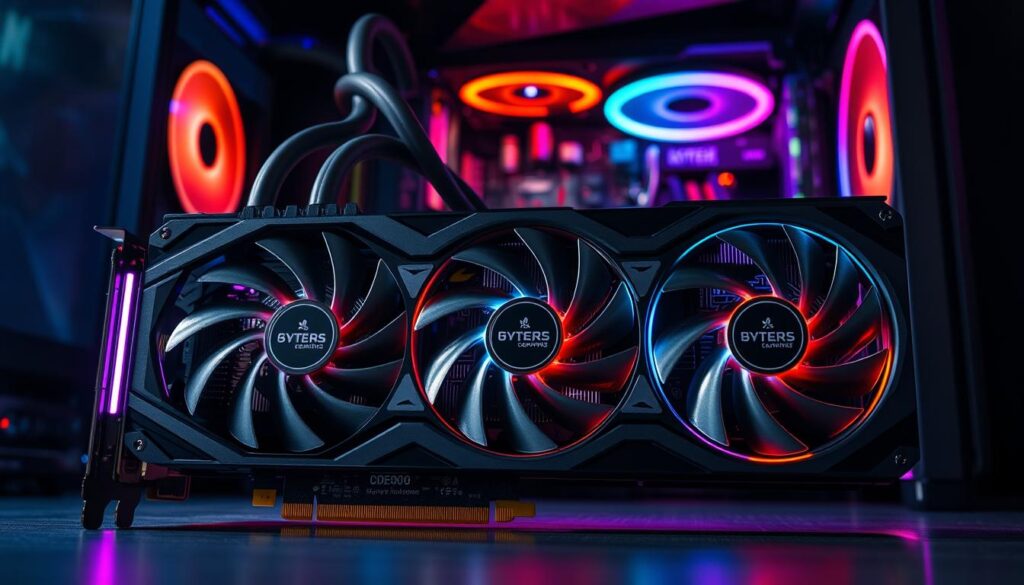
Effective cooling matters as much as raw speed. If a card cannot shed heat during heavy ray tracing runs, its boost clock will fall and fps will drop.
I prefer cards with large heatsinks, heat pipes, and stable fan curves. These usually keep clocks steady over long play sessions and extend the card’s useful life.
- I check the physical dimensions and clearance in the most common cases.
- Cooling performance directly affects boost clock stability under load.
- For compact builds, form factor is as important as fps in real games.
- Robust coolers handle the extra heat from ray tracing workloads better.
| Factor | Why it matters | Practical tip |
|---|---|---|
| Length / Height | Determines fit in SFF and mid-tower cases | Measure case clearance before you buy |
| Cooling design | Affects sustained performance and noise | Favor multi-heatpipe coolers or dual fans |
| Power & airflow | Controls temps during heavy GPU loads | Ensure good case airflow and PSU headroom |
“Pick a card that fits your case and keeps its boost clock under long sessions.”
Identifying Value in a Volatile Market
I watch street prices closely because the sticker on the box rarely reflects what you’ll actually pay.
When the market shifts, the live price of a graphics card tells you more than MSRP ever will. I track daily listings across major retailers so I can spot real deals fast.
Value for me means the best performance per dollar today and sensible longevity for tomorrow. That means choosing a model that matches your performance needs and holds up for a few years.
- I track the street price of every graphics card I review so you see current trends.
- Compare multiple sellers before you buy—prices can change day to day.
- Don’t chase the lowest tag alone; balance price with expected performance and memory needs.
- Be patient: waiting for a fair offer often nets better long-term satisfaction.
“Watch what sellers charge today; that is the truest measure of a card’s worth in a volatile retail climate.”
| What I Track | Why it Matters | Actionable Check |
|---|---|---|
| Street price | Reflects real cost to buyers | Compare three retailers before purchasing |
| Performance per dollar | Shows practical value | Prioritize consistent fps and adequate VRAM |
| Restock cadence | Signals short-term price moves | Set alerts and wait for a stable offer |
When to Upgrade Your Existing System
If your older rig struggles to keep frame times steady, a targeted GPU upgrade is usually the fastest path to smoother play.
I recommend upgrading when your current graphics card can no longer hold a stable frame rate in the games you play most. That kind of drop directly harms the feel of play and your enjoyment.
Adding a modern GeForce RTX model to an older build often delivers the biggest single uplift in perceived performance. It can unlock better upscaling and frame generation in supported titles.
You should evaluate your whole system before you buy. A fast new GPU can be bottlenecked by an old CPU or slow memory. If the CPU limits frame pacing, the upgrade won’t reach its potential.
“Upgrade when hardware actively prevents you from enjoying your favorite games.”
- I advise upgrading only when the current setup stops delivering smooth play for your most-played titles.
- Weigh the cost of a new GPU against other upgrades—sometimes a CPU or RAM update matters first.
- Choose a card that fits your case, PSU, and personal performance needs.
| Trigger | What to Check | Suggested Action |
|---|---|---|
| Frequent stutters or low minimum FPS | Frame time charts, in-game minima | Consider a GPU upgrade |
| New games demand features your GPU lacks | Support for upscaling/frame generation | Pick a GeForce RTX or equivalent |
| CPU bottleneck causes low utilization | CPU usage during play, core speeds | Upgrade CPU or balance parts first |
Future Proofing Your Gaming Rig
A future-proof rig starts with a GPU that outpaces current game demands.
I recommend choosing hardware that comfortably handles both 1080 gaming and 1440 gaming. That means a modern generation GPU with extra vram and solid memory bandwidth.
Invest in at least 12–16GB of GDDR6 or better memory if you want room for higher texture packs and ray tracing in modern games.
Think about power and cooling as part of the cost. A strong cooler and a quality PSU keep a card’s boost clock stable and protect long-term gaming performance.
Choose GPUs that support current upscaling and frame generation tech. In my review work, I see nvidia rtx and amd radeon offerings add real value by extending usable life through software features.
“Buy a card that gives you headroom — more memory and newer features pay off over time.”
- I favor options with extra memory to avoid early obsolescence in modern games.
- Pick models that include ray tracing and frame generation to keep visuals and smoothness current.
- Plan for cooling and power so the system won’t bottleneck a strong GPU later.
| Factor | Recommended Spec | Why it Matters |
|---|---|---|
| VRAM | 12–16GB GDDR6 | Handles high-res textures and future game demands |
| Power & Cooling | Quality 600W+ PSU; robust cooler | Maintains boost clock and prevents thermal throttling |
| Feature Support | Ray tracing, frame generation, modern upscaling | Extends usable life via software improvements |
Conclusion
Wrapping up, aim for sustained performance and sensible feature support when you pick hardware.
I recommend choosing a graphics card that keeps frame times steady in the games you play. Consider how long it will serve you and how it fits your system.
Whether you lean toward nvidia rtx or amd radeon, compare real-world fps against price and feature sets. The rtx 5060 remains a solid, efficient option for many builders.
My goal was to help you find the best graphics choice that balances short-term needs with long-term value. Choose based on your play style and system limits for the best outcome.
FAQ
Which GPUs deliver the best high-FPS performance at 1080 resolution for under 0?
I usually look for cards with good raster performance, at least 6–8 GB of GDDR6 memory, and strong driver support. Current contenders from NVIDIA GeForce RTX 40- and 30-series entry-level SKUs and Intel Arc entries often hit high frame rates in esports titles. For modern AAA games I favor cards that include hardware ray tracing and support DLSS or similar upscaling to boost fps without large drops in quality.
How has the graphics card market changed recently?
Supply stabilized after the crunch years, but AI demand and new GPU launches shifted pricing and availability. I see stronger segmentation: entry-level parts target value gamers, midrange chips chase high-refresh monitors, and high-end GPUs lean into AI and ray tracing performance, which raises average prices across generations.
Why are affordable GPUs still relevant for most gamers?
Most players game at 1080 or 1440 and prioritize high frame rates over ultra settings. I find affordable GPUs let you play current titles smoothly with smart settings and upscaling, keep power and thermal demands lower, and provide the best cost-to-fps for competitive play.
What metrics should I check when comparing modern GPUs?
I compare average fps in relevant games, 1% lows, memory size and bandwidth, boost clock, TDP, and driver features like upscaling. Real-world benchmarks at target resolution matter more than synthetic scores when predicting gaming experience.
How much does upscaling help performance, and which tech is best?
Upscaling can significantly increase fps with minimal visual loss. I prefer NVIDIA DLSS for titles that support it thanks to consistent quality and frame generation options. AMD FSR and Intel XeSS also provide broad support and good quality, especially where DLSS isn’t available.
Is frame generation worth it for competitive gamers?
Frame generation boosts perceived smoothness and can raise effective fps, but it can add latency in some scenarios. I recommend testing it in your favorite titles; for single-player or high-refresh casual play it’s great, while some esports players may prefer raw frame time predictability.
How much VRAM do modern games need at 1080 and 1440?
For 1080 gaming I advise at least 6–8 GB for current titles; for 1440 you should aim for 8–12 GB depending on texture packs and mods. Higher VRAM helps with ultra texture settings and future-proofs your system as asset sizes grow.
Are Intel Arc GPUs a viable option for entry-level builds?
Intel Arc offers competitive raster performance and strong upscaling via XeSS. I find their value depends on driver maturity for specific games. They’re a solid option if you compare real benchmarks for the games you play and confirm stable driver support.
Which midrange GPUs are best for high-refresh 1080 and 1440 monitors?
I recommend GPUs that balance raw fps and ray-tracing capability while offering hardware upscaling. Look at recent GeForce RTX and AMD Radeon midrange models that deliver consistent 100+ fps at 1080 and 60–120+ fps at 1440 in modern titles.
Does AI demand affect GPU prices and availability?
Yes. Increased interest in AI compute pushes demand for higher-end GPUs and sometimes lifts prices across the board. I watch supply-chain news and vendor promotions to spot the best windows for purchases.
How do you test graphics cards to ensure accurate results?
I run repeatable benchmark suites on a controlled test bench, measure average fps and 1% lows in multiple titles, log power draw and thermals, and test with and without upscaling. I also verify driver versions and settings so results reflect typical user scenarios.
How important is cooling and case airflow for small GPUs?
Cooling is critical. Even compact cards can thermal throttle in poor airflow. I recommend cases with good intake and exhaust, and cards with robust cooling designs—dual fans or vapor chambers—for sustained performance and quieter operation.
What power supply should I use for a midrange build?
Check the GPU’s TDP and add headroom for the CPU and peripherals. For most midrange cards a quality 500–650W PSU is fine; higher-end or overclocked systems should use 750W+ units with the right PCIe connectors and an 80 Plus Gold rating for efficiency.
How do AMD and NVIDIA software ecosystems compare?
NVIDIA offers mature features like DLSS, Reflex, and widely supported drivers. AMD provides FSR and competitive driver updates, often with attractive pricing. I choose based on which ecosystem offers features I need—ray tracing tools, upscaling quality, and game-specific optimizations.
When should I consider upgrading my GPU?
I upgrade when my current card can’t meet target frame rates in the games I play, when key features like ray tracing or AI upscaling are missing, or when driver support ends. Budget, power limits, and compatibility with my CPU and monitor also guide my timing.
How can I future-proof a new gaming rig?
I prioritize a GPU with ample VRAM, good driver support, and modern features like hardware ray tracing and upscaling. Pair it with a motherboard that supports future CPU upgrades and a PSU with spare capacity to extend the system’s useful life.

Ethan is a lead GPU reviewer and hardware analyst with a passion for pushing silicon to its absolute limits. With a background in computer engineering, he spends his days building custom test benches, analyzing frame-time graphs, and breaking down complex GPU architectures. When he’s not benchmarking the latest NVIDIA and AMD releases for VN Pixel, he is likely tweaking his custom-loop water-cooling setup to achieve the perfect overclock.