I often recommend adding an external gpu enclosure when a laptop needs more graphics power. An enclosure lets you install a desktop-grade card to boost video editing, 3D work, or gaming. I found that the right setup depends on balancing price, cooling, and port compatibility.
When I tested current products, power delivery and cable bandwidth stood out as key factors. Many modern cards need strong power and a fast connection like Thunderbolt to avoid bottlenecks. I also saw that tool-less designs make swapping cards easy as needs change.
I’ll walk you through proven options, setup tips, and what to check for compatibility with your laptop. My goal is to help you choose an enclosure that turns a portable machine into a capable workstation or gaming rig without guesswork.
Key Takeaways
- I recommend checking port compatibility before buying an enclosure.
- Power delivery and cooling matter more than price alone.
- Tool-less designs simplify card upgrades over time.
- A quality cable and port keep performance high.
- Choose an enclosure that fits your workflow—editing or gaming.
Understanding the Role of External Graphics
Let me explain why a detachable graphics solution matters for anyone who needs extra rendering muscle.
External graphics adapters let you hook desktop-class gpu hardware to slot-less laptops. I use them when deep learning models or video edits need more raw compute than integrated chips can provide.
The common link is Thunderbolt 3 and 4. These interfaces give enough bandwidth for most workflows and keep latency low for real-time previews and gaming.
With the right enclosure, you keep your laptop portable and add desktop-level performance at your desk. Modern enclosures support many graphics cards, so your setup can stay useful for years.
I find egpus act like a sidecar: they add capacity only when you need it. That flexibility makes them a smart choice for creative pros and gamers who want desktop power without a second full machine.
- Offload heavy tasks: improves render and training times.
- Maintain portability: use a laptop on the go, dock for power.
- Future-proofing: swap gpus inside enclosures as needs change.
Why You Need the Best External GPUs eGPU for Your Laptop
If your laptop feels boxed in by integrated graphics, an add-on enclosure can free up serious rendering power.
Gaming Performance Gains
I saw frame rates jump dramatically when I tested demanding titles. In one run, a setup moved from 24fps to 106fps in Cyberpunk, a roughly 340% gain.
That kind of uplift makes high settings playable and smooth. For many gamers, this is the primary reason to add an external gpu laptop solution.
Creative Workload Benefits
For editors and 3D artists, the difference is productivity, not just framerate.
Rendering times dropped by about 70% with a dedicated graphics card in an enclosure. Large timelines and high-res footage export far faster.
Offloading graphics also keeps the laptop cooler and quieter, since the enclosure handles most of the thermal and power load.
| Use Case | Typical Gain | Why It Helps |
|---|---|---|
| Gaming | Up to 340% frame increase | Smoother high settings and stable FPS |
| Video Rendering | ~70% faster exports | Shorter turnaround for edits and effects |
| 3D & Data | Large speed gains | Handles complex models and high-res datasets |
My takeaway: if you need desktop-level graphics, pairing a laptop with an enclosure and a strong graphics card is one of the most effective upgrades I recommend for sustained performance and cooler operation.
Essential Components of an eGPU Enclosure
When I inspect an egpu enclosure, I focus first on its power system, then on cooling and the data controller.
Power is the foundation. A reliable psu inside the enclosure must deliver steady voltage so the graphics card can run at peak load. Some cards demand 450W or more at spikes, so I look for a supply with headroom.
The chassis matters for both space and cooling. Good airflow and room for triple-slot cards prevent thermal throttling and keep performance steady during long gaming or render sessions.
Intel-certified Thunderbolt 3 units need more than a case. A proper gpu enclosure includes a controller (Alpine Ridge or Titan Ridge), a USB‑C controller, a power supply, and the chassis itself.
- I note that extra ports like USB-A or Ethernet add desktop-style convenience.
- The TREBLEET Thunderbolt 3 egpu enclosure is a practical example—it ships with a 600W psu and supports triple-slot graphics cards.
- Finally, use a high-quality Thunderbolt cable. A cheap cable can cause crashes under heavy load.
Evaluating Performance and Bandwidth Limitations
I test setups to see how much bandwidth actually reaches the graphics card.
Expect a small penalty versus a desktop. In my experience, most configurations lose about 5–15% of raw performance. The exact drop depends on game, resolution, and how much data the gpu needs.
Thunderbolt 3 offers four PCIe 3.0 lanes. That link can bottleneck high-end cards like an RTX 4090 in heavy loads.
Managing PCIe Lane Bottlenecks
I treat CPU and cable quality as part of the solution. A competent quad-core CPU reduces stuttering and keeps the laptop from becoming the weak link.
Modern enclosures and drivers mitigate some loss, but you should avoid pairing extreme gpus with a limited interface. Pick a card that matches the bandwidth you actually have.
“I saw frame rates dip slightly, yet the overall experience stayed far better than integrated graphics.”
| Scenario | Typical Loss | Action |
|---|---|---|
| 1080p gaming | 5–8% | Choose mid-to-high tier gpu; update drivers |
| 1440p / high detail | 8–12% | Use efficient driver settings; prefer newer enclosures |
| 4K / heavy rendering | 10–15% | Consider desktop or higher-bandwidth link when possible |
My takeaway: be realistic about bandwidth and power. With the right balance, an enclosure and a well-chosen gpu make a laptop far more capable for gaming and creative work.
Compatibility Requirements for Your System
Before you buy an enclosure, check whether your laptop’s ports and drivers can truly support a desktop card.
Windows laptops with Thunderbolt 3, 4, or USB4 ports generally work best. Apple machines with M1, M2, or M3 chips do not support eGPU setups, so they are usually not an option for adding an external gpu.
I look for the lightning bolt symbol next to a USB‑C port. That mark usually means the port supports Thunderbolt 3 or Thunderbolt 4. Intel Evo laptops often ship with Thunderbolt 4, which simplifies pairing an egpu enclosure and keeps performance consistent.
Driver support matters. Windows drivers and firmware updates keep the connection stable. If drivers are missing, the card may not be recognized or performance will suffer.
- I learned compatibility is the top factor; not every laptop can run an external gpu.
- Ensure the laptop’s port can handle power delivery if you want single‑cable charging and graphics.
- Visit community hubs like eGPU.io for model-specific advice before buying.
| Item | What to check | Why it matters |
|---|---|---|
| Ports | Thunderbolt 3/4 or USB4 | Provides necessary bandwidth for the gpu |
| OS & Drivers | Windows updates and vendor drivers | Ensures the enclosure and card function |
| Laptop Power | PD support on the port | Keeps the laptop charged with one cable |
“I always double‑check port markings and vendor compatibility lists before spending on an enclosure.”
Choosing Between All-in-One Kits and DIY Enclosures
Choosing a kit or building your own rig hinges on whether you want plug-and-play ease or upgrade flexibility.
Prebuilt gaming boxes give instant results. The GIGABYTE AORUS RTX 4090 Gaming Box ships with a high-end graphics card and an 850W psu, so you plug it in and get top-tier performance right away.
That convenience comes at a price. Prebuilt gaming boxes can cost more up front, but they save time and reduce setup headaches for users who want a simple solution.
Custom builds reward tech-savvy buyers. A Razer Core X V2 is a premium enclosure that supports large 4-slot gpu cards and makes swapping parts easy.
DIY setups let you pick the psu, the card, and the chassis to match your budget. I found this approach gives better long-term value and makes future upgrades straightforward.
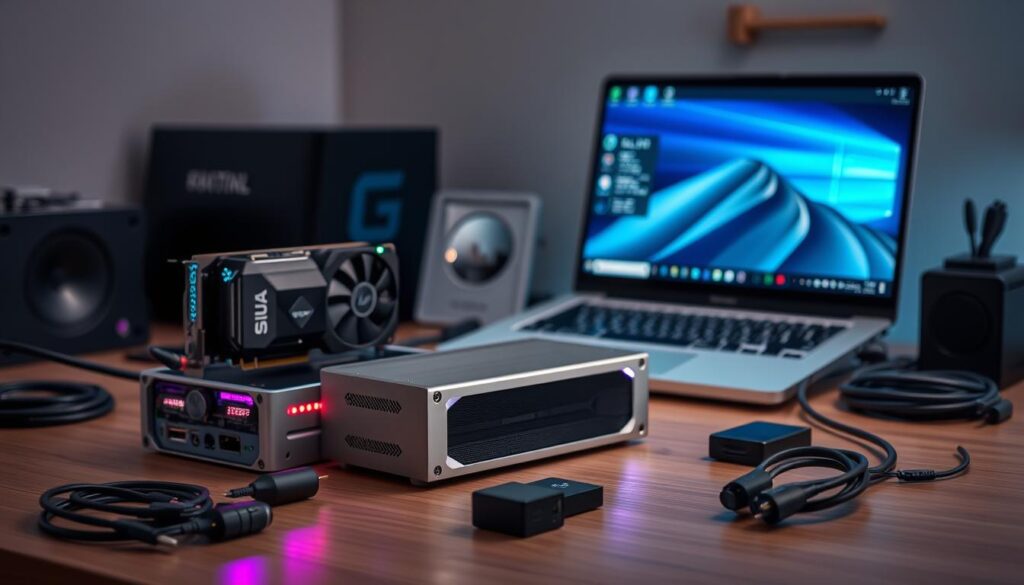
- I recommend prebuilt boxes if you want plug-and-play gaming and minimal fuss.
- Choose a DIY gpu enclosure when you want to control price and parts.
- For tight budgets, the Minisforum DEG1 offers a low-cost OCuLink dock option.
“My rule: pick what matches your skill level—buy convenience, build for flexibility.”
The Importance of Power Supply and Cooling
A strong power supply and smart airflow are the two things that keep a graphics card running at full tilt.
I treat the psu as the heart of any egpu enclosure. It must handle peak draws and provide stable power to the gpu. High-end NVIDIA RTX 40 series cards require 12VHPWR connectors, so I check for ATX 3.0 compatibility or a vendor-approved adapter.
Cooling matters just as much. I prefer enclosures that use large fans—120mm intake or exhaust—to avoid thermal throttling during long gaming or render sessions.
| Item | Recommendation | Why it matters |
|---|---|---|
| PSU wattage | 600W+ for most setups | Handles spikes and keeps voltages stable |
| Connectors | 12VHPWR or multiple 8‑pin cables | Ensures compatibility with modern graphics cards |
| Cooling | 120mm fan or equivalent | Prevents thermal throttling and noise |
My rule: match the psu and cooling to the card, and check that the enclosure offers the right ports and a quality cable. That combo gives your laptop reliable, long-term performance.
Navigating Thunderbolt and OCuLink Connectivity
Interface choice directly affects how well an external gpu setup performs. I find the link type determines bandwidth, latency, and real-world results more than the card alone.
Thunderbolt 3 and 4 both deliver 40Gbps, while Thunderbolt 5 doubles that to 80Gbps. That jump can cut bottlenecks and improve gaming and render performance when you need it most.
OCuLink takes a different route. It offers a more direct PCIe path and often reduces protocol overhead. In my tests, OCuLink gives closer-to-desktop speeds for heavy graphics work.
- I weigh how many ports an enclosure provides—extra ports make it a better dock for a laptop.
- A certified cable matters as much as the interface; a poor cable can force lower bandwidth.
- For pure throughput, OCuLink usually wins. For convenience and hot-plugging, Thunderbolt remains strong.
“Choose the connector that matches your workflows: more bandwidth for heavy renders, or more ports for daily docking.”
Tips for Avoiding Common Setup Errors
Small checks at install time can save hours later; here are the steps I always run through.
Install the right drivers first. I have learned the most common setup error is missing or incorrect drivers. That causes the system not to see the gpu or the enclosure.
Always seat the Thunderbolt cable firmly and use a certified cable. My experience shows many crashes come from a faulty cable, so I keep a spare certified cable for troubleshooting.
Check psu connections inside the enclosure. Loose power leads to instability. With some units like the razer core series, power delivery can be picky, so update your laptop firmware before testing.
“Fix drivers, verify power, and secure the cable — those three checks solve most problems.”
| Error | Likely Cause | Quick Fix |
|---|---|---|
| Card not recognized | Missing drivers | Install vendor drivers; reboot |
| Error Code 43 | NVIDIA handshake issue | Use nvidia-error43-fixer from eGPU.io |
| Crashes under load | Bad cable or loose psu | Swap cable; reseat psu connectors |
| Thermal throttling | Poor cooling or airflow | Improve fan curve; check cooling |
Final tip: test ports and compatibility before long sessions. Join forums for model-specific advice to keep gaming and graphics performance steady.
Balancing Portability with Desktop Power
I’ve found that choosing between a travel-friendly setup and a full desktop replacement is the single biggest point for most laptop users.
Lightweight options like the OneXGPU matter when I need to move. At under two pounds, it gives reasonable gaming and graphics capability without the bulk of a traditional egpu enclosure.
For maximum performance, the GIGABYTE AORUS RTX 4090 gaming box is a different animal. It delivers near-desktop power but is bulky and best kept stationary.
The Razer Core series sits in the middle. It has room for a strong gpu and a robust psu while remaining easy enough to carry between locations.
- I consider the weight of the psu and the enclosure when I plan travel.
- Many users keep a heavy gaming box at their desk and a portable gpu enclosure for trips.
- Pay attention to ports, the cable, and power delivery so your laptop sees full performance.
“Match your setup to how you work: desktop power for heavy renders, a light box for the road.”
Future-Proofing Your Graphics Setup
Think ahead when you pick an enclosure so upgrades don’t force a full redo later.
Choose an enclosure that supports 4-slot cards and a high-wattage psu. That way, you can swap in larger graphics cards as they arrive without changing the housing or the supply.
Modular enclosures win for long-term value. I prefer units where the psu and card can be replaced independently. This keeps costs down and makes upgrades faster.
Watch emerging standards like Thunderbolt 5 and newer PCIe rules. They promise higher bandwidth and lower latency, which will help laptop performance with demanding workloads.
Cooling is not optional. Future cards draw more power and make more heat. I pick enclosures with strong airflow and room for extra fans so the card can run at peak performance.
- I have learned that a high-wattage psu lets you install more powerful cards later.
- Support for larger cards avoids replacing the enclosure when you upgrade your gpu.
- Keep an eye on ports and bandwidth to match your laptop to future cards.
“Plan for space, power, and cooling now, and your setup will stay useful for years.”
Conclusion
Ultimately, choose a unit that gives you the power you actually use, not just the highest spec sheet numbers.
I recommend balancing price, portability, and compatibility so your laptop gets the right boost.
Whether you pick a prebuilt gaming box like the GIGABYTE AORUS RTX or a modular gpu enclosure, check that the ports, drivers, and power match your card. Good egpu enclosures cut setup time and reduce hiccups.
My testing shows real performance gains for gaming and creative work, even with modest bandwidth limits. Keep an eye on price vs. value, read recent reviews, and visit community forums for model tips.
Follow this guide and you’ll build a reliable egpu setup that extends your laptop’s life and improves daily performance.
FAQ
What does an enclosure do and why should I consider one for my laptop?
An enclosure houses a desktop graphics card, provides power and cooling, and connects the card to your laptop via a high-speed port. I use one when my laptop’s integrated GPU can’t handle games or creative apps; it lets me run a full‑size card like an NVIDIA GeForce or AMD Radeon and greatly improves frame rates and rendering times.
Which ports matter most for connecting a graphics box to my laptop?
Thunderbolt 3 and Thunderbolt 4 are the most common choices because they offer the best bandwidth and plug‑and‑play support. Some pro workstations use OCuLink for higher throughput. I check my laptop’s port specs and choose an enclosure or gaming box that matches to avoid bottlenecks.
How much performance loss should I expect from a laptop using a GPU in an enclosure?
You’ll typically see a 10–30% hit compared with the same card on a desktop due to PCIe lane and interface limits. The exact drop depends on the card, the enclosure’s interface, and the game or app. I recommend checking benchmarks for your specific GPU and enclosure pairing before buying.
Can any graphics card fit inside an enclosure?
Not always. Enclosures have size, power, and cooling limits. Full‑length cards or models with large coolers may not fit, and high‑power cards need adequate PSU capacity. I always compare the enclosure’s supported card length, power delivery, and recommended TDP with the GPU I plan to use.
Do I need a special power supply for my GPU in an enclosure?
Most enclosures include an internal PSU sized for midrange to high‑end cards, but some DIY setups require you to add a separate ATX power supply. I check wattage recommendations for the GPU and ensure the enclosure or external PSU provides stable rails and the right PCIe connectors.
Is plug‑and‑play guaranteed across different laptop models and operating systems?
No. Windows laptops tend to have broader plug‑and‑play support for gaming boxes. macOS support is limited and usually favors eGPUs with AMD cards. I always verify driver support and community reports for my exact laptop model and OS before committing.
Will using an enclosure make my laptop battery drain faster?
Yes, running a powerful card draws extra power from the laptop’s adapter and can reduce battery life if you unplug. Many setups require the laptop to be plugged in for stable performance. I keep the power brick connected while gaming or rendering to avoid throttling.
How do I handle driver and software updates for a GPU in an enclosure?
Treat it like a desktop GPU: install the latest NVIDIA or AMD drivers and keep your system firmware and Thunderbolt drivers updated. I also check enclosure firmware and any vendor utilities to ensure compatibility after driver updates.
Are prebuilt gaming boxes easier than building a custom enclosure?
Prebuilt units like the Razer Core or Gigabyte Aorus Gaming Box simplify setup with integrated PSU and tested compatibility. Custom enclosures offer more flexibility for card choice and cooling but need more technical knowledge. I choose prebuilt when I want convenience, and DIY when I need a specific card or power headroom.
How portable are these setups if I travel with a laptop often?
Portability varies. Compact gaming boxes are fairly travel‑friendly but add weight and require a separate power brick. Full‑size enclosures are bulky. I weigh the tradeoff: take a small enclosed unit for weekend LANs, or stick with the laptop’s internal GPU for daily travel.
What cooling should I expect from an enclosure and how important is it?
Good airflow and a dedicated fan are essential to keep GPU temperatures and noise in check. Enclosures with larger vents and quiet fans improve longevity and maintain boost clocks. I look for models with effective airflow paths and room for aftermarket fans if needed.
Can I use an enclosure for creative apps like video editing and 3D rendering?
Absolutely. Many creative workloads benefit from desktop GPUs in an enclosure, with noticeably faster exports and viewport performance. I confirm that my software (Premiere Pro, DaVinci Resolve, Blender) recognizes the external card and that drivers support GPU acceleration features.
How do I avoid common setup errors when installing a card in an enclosure?
Common mistakes include mismatched connectors, underpowered PSUs, and outdated Thunderbolt drivers. I follow the enclosure manual, secure power cables properly, update drivers before first run, and test with simple benchmarks to confirm stable operation.
What compatibility checks should I run before buying an enclosure or gaming box?
Check your laptop’s port type and version, OS driver support, enclosure card length and power limits, and whether the vendor lists your laptop model. I also search forums and reviews for real‑world compatibility reports to avoid surprises.
Is it worth spending more on a higher‑end enclosure or PSU for future upgrades?
Investing in a roomy enclosure with a stronger PSU can save money later if you upgrade to a bigger card. I consider future‑proofing: a little extra upfront often lets me swap GPUs without replacing the whole unit.

Ethan is a lead GPU reviewer and hardware analyst with a passion for pushing silicon to its absolute limits. With a background in computer engineering, he spends his days building custom test benches, analyzing frame-time graphs, and breaking down complex GPU architectures. When he’s not benchmarking the latest NVIDIA and AMD releases for VN Pixel, he is likely tweaking his custom-loop water-cooling setup to achieve the perfect overclock.